A frontier market driven by reforms, with improving fundamentals
Since 2016, the country has been engaged in a sweeping reform program to overhaul its macroeconomic framework and governance standards. Since then, the economy has grown by an average of 5.8% per year, supported by strong domestic demand, steady investment flows, and increased integration into the global economy.
For investors seeking diversification beyond saturated emerging-market markets and looking for value in credits that are still under-covered, the country offers a rare combination: improving macroeconomic fundamentals, a credible reform agenda, and a growing pipeline of corporate issuers, supported by the government’s strategic commitment to attracting private capital.
IVO Capital Partners’ Perspective
- The sovereign’s reform trajectory provides implicit support to the country’s leading companies. The high level of state ownership, combined with active governance reform, reduces extreme risk compared to many frontier peers.
- Gold reserves provide macroeconomic stability and strong external liquidity—key assets in a volatile global environment.
- Uzbekistan remains relatively underrepresented in international portfolios, but is gaining visibility in the market
Improving macroeconomic fundamentals
A trend of sustained growth
Uzbekistan has been experiencing sustained economic growth, with a compound annual growth rate of 5.8% since 2017, outperforming its peers* in the Commonwealth of Independent States (CIS), whose average stands at 4.7%**. This momentum is driven by gold production and exports, which are benefiting from high global prices; by major public investment programs, particularly in infrastructure and energy; and by a young and growing population, which supports consumption and the labor supply.
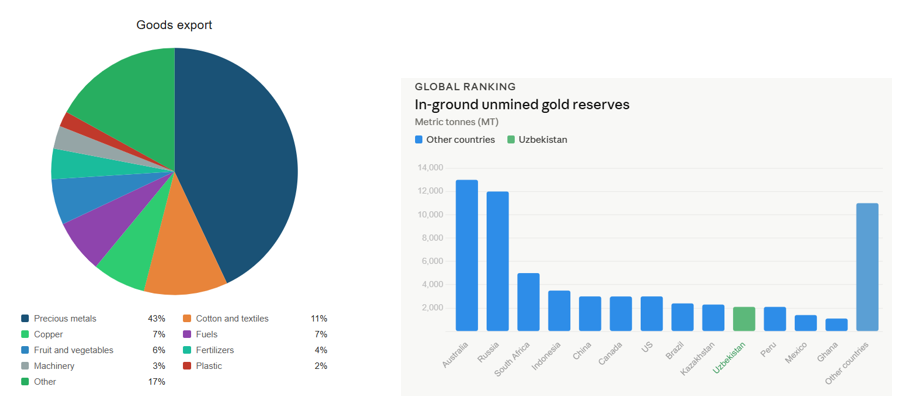
The country is the world’s 10th-largest gold producer and a major holder of gold resources (5th in the world in terms of reserves, 10th in terms of estimated unexploited reserves). It is also among the world leaders in uranium (12th), copper (8th), and potash reserves (4th).
*Including Kazakhstan, Kyrgyzstan, Tajikistan, Uzbekistan, and Turkmenistan
** CAGR weighted by real GDP (2017–2024)
Foreign trade remains central to the Uzbek economy, accounting for 61% of GDP in 2024, with a total volume of $66 billion. The country trades with 198 partners, led by China (18.9%) and Russia (17.6%), followed by Kazakhstan, Turkey, and South Korea. The CIS’s share has risen to 35%, reflecting the strengthening of regional integration.
As a producer of oil, natural gas, gold, and cotton, the country’s exports are dominated by natural resources. Goods account for about three-quarters of total exports, while services—which make up about one-quarter—are growing steadily, particularly in tourism and transportation. Exports of goods consist mainly of precious metals (43%), cotton (11%), fuels (7%), and copper (7%).
Source: U.S. Geological Survey
Sturdy external shock absorbers
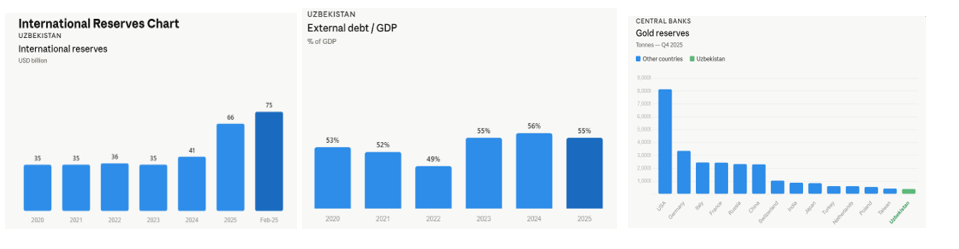
Uzbekistan’s international reserves rose from 41 billion USD at the end of 2024 to approximately 70.9 billion USD as of May 1, 2026, providing solid coverage against total external debt of approximately 82 billion USD (as of December 2025), equivalent to about 16 months of imports and four times the short-term external debt. Gold accounts for approximately 85% of total reserves, providing a natural hedge during periods of global uncertainty, when flows into safe-haven assets typically drive prices higher. The rise in gold prices during 2024–2025 strengthened the reserve buffers, improving external resilience and supporting sovereign credit quality. The country’s gold reserves ranked 14th globally in Q4 2025, ahead of many much larger economies.
Sources: Central Bank of Uzbekistan, Ministry of Finance of Uzbekistan, World Gold Council
Prudent Debt Management and Economic Policy Anchors
External debt remains under control: the majority of it is owed to multilateral and official creditors, with long maturities and on concessional terms, which limits refinancing risk and market risk. The adoption of a public debt law in April 2023 established a formal ceiling of 60% of Gross Domestic Product (GDP), with corrective measures triggered at 50%, thereby strengthening fiscal discipline. Total public debt, including state-guaranteed liabilities, stood at approximately 32% of GDP in 2025, well below statutory thresholds, which supports the improvement in Uzbekistan’s sovereign credit profile and macroeconomic resilience.
Path of Reforms and Privatizations
A post-Soviet, state-run economy in transition
As a post-Soviet economy that gained independence in 1991, Uzbekistan inherited an economic structure that was heavily controlled by the state. Since 2016, under the presidency of Shavkat Mirziyoyev, the country has embarked on one of the most ambitious reform programs in the region.
The turning point came in 2017 with the liberalization of the exchange rate, which put an end to the dual-currency system that had long discouraged foreign investment and distorted price signals. Far more than a technical adjustment, this decision marked a return to macroeconomic normality and alignment with international standards.
Key reforms include:
- Tax Reform and Regulatory Simplification
- Deregulation of Energy Rates
- Elimination of the state cotton quota system and forced labor (the cotton boycott was lifted in 2022, significantly improving the country’s ESG profile)
The early presidential election in July 2023 extended President Mirziyoyev’s term by seven additional years, while the ruling party retained its parliamentary majority in the October 2024 elections. Political continuity has bolstered the credibility of this reform path and reduced short-term economic policy uncertainty.
Privatization: The Next Catalyst
Privatization has become the cornerstone of this reform program. The government’s goal is not limited to the sale of assets; it aims to transform governance. Initial public offerings (IPOs) of major state-owned enterprises include Navoi Mining (NMMC), the country’s leading gold and uranium producer; Uzbekneftegaz, the national oil and gas company; two major state-owned banks, SQB and Asaka; and UzNIF, the National Investment Fund of the Republic of Uzbekistan, managed by Franklin Templeton and comprising a portfolio of 13 assets. On May 13, 2026, UzNIF completed a dual listing in London and Tashkent, raising $604 million through the sale of a 31% stake. The offering was oversubscribed three times, marking the first international share offering by an Uzbek company and a major milestone for Uzbek capital markets.
The strategy is clear: to increase transparency, strengthen balance sheets, attract strategic investors, and gradually reduce the sovereign risk premium, following the path previously taken by neighboring Kazakhstan.
Key Risks
Like any frontier market, Uzbekistan presents a number of risks that investors must take into account, although it is characterized by a strengthening macroeconomic framework and a clear reform trajectory.
- The economy remains exposed to gold (43% of goods exports in 2025), which implies sensitivity to commodity prices. However, even under more moderate price assumptions, export revenues are expected to remain supportive of the external balance.
- Sustained growth and ambitious public investment programs require economic policy discipline to prevent overheating. Dollarization is declining but remains relatively high (41% of loans; 26% of deposits), leaving room for further deepening of the financial system.
- Domestic capital markets are still developing, which limits long-term financing in local currency. Budget deficits reflect import needs and growth-driven investments, while the shift to net gas importer status in 2023 reflects rising domestic demand.
- Finally, regional geopolitical dynamics—particularly ties with Russia—can affect remittances, trade flows, and market sentiment. Nevertheless, stronger buffers and greater credibility in economic policy have made the economy more resilient than in the past.
Overall, while Uzbekistan remains in a state of transition, the trajectory is positive, and the risks appear manageable within the context of the broader reform process.
Investment Opportunities: A Growing Pool of Corporate Issuers
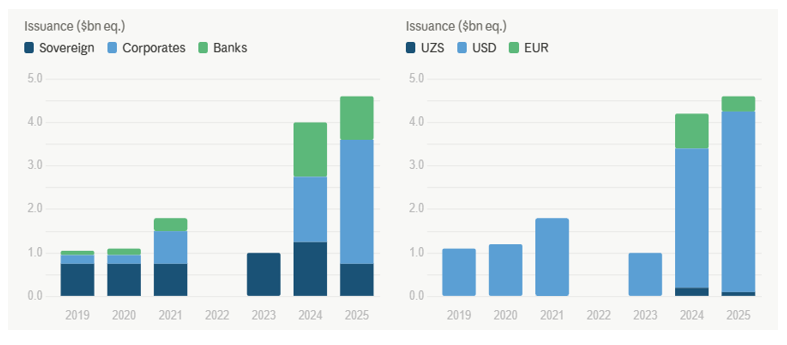
Since its first sovereign bond issuance in 2019, Uzbekistan has gradually strengthened its presence in international capital markets. Corporate bond issuance has also picked up pace, with both new and repeat issuers tapping the market. The main issuer segments include banks as well as companies in the energy and mining sectors. State-owned enterprises are becoming more investor-friendly: the shift toward greater transparency is essential for attracting long-term institutional capital.
Sources: Central Bank of Uzbekistan, Ministry of Finance of Uzbekistan, World Gold Council
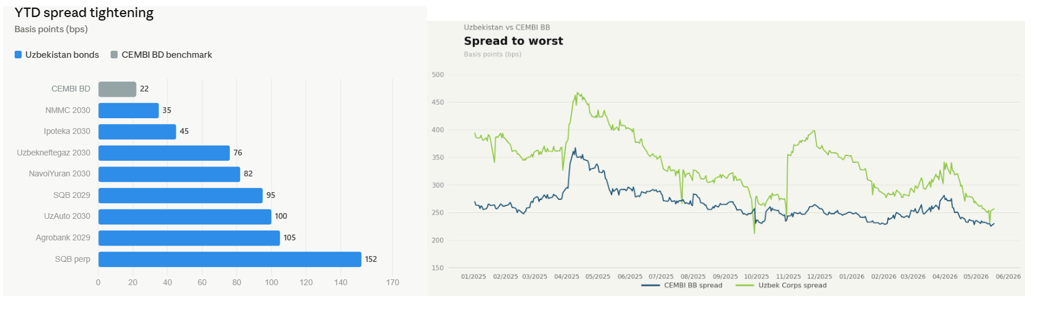
Spreads on Uzbek corporate bonds have narrowed significantly over the past three months, substantially outperforming the CEMBI index, while continuing to offer a spread premium relative to comparable issuers with the same credit rating.
A prime example of this transformation is the Uzbekistan Industrial and Construction Bank (SQB), one of the holdings in our fund. Formerly a state-run lender, SQB underwent sweeping reforms and balance-sheet restructuring to become a market-oriented universal bank. It has since achieved two major milestones: the issuance of the country’s very first AT1 bond, and its move toward privatization through the UzNIF IPO. The AT1 is trading above par at 103.9 as of May 20, 2026, offering a yield of 8.4%, which remains attractive for a state-owned banking instrument. It should be noted that the structure does not include a mechanical trigger, while the PONV trigger is statutory; we estimate the probability of activation to be low given SQB’s close ties to the government and its role as the flagship of Uzbekistan’s privatization agenda. The bank’s stability is thus closely linked to the credibility of the broader reform program.
Sources: Bloomberg (JCBDBXTW Index & JCBDUZTW Index)
Issuances denominated in local currency and in ESG format are gaining ground
While the U.S. dollar remains dominant, issuances in Uzbek sum (UZS) have increased, attracting interest from both local and international investors. Green and sustainable bond issues have also emerged, driven by strategic national projects such as water efficiency, renewable energy, and sustainable agriculture.
Conclusion
Uzbekistan’s credit history is evolving rapidly. Companies are following the government’s reform path, supported by:
- Strong government support
- Improving fundamentals
- A clear commitment to attracting private capital
- A growing and increasingly transparent database of issuers
In less than a decade, Uzbekistan has transitioned from a largely administered and inward-looking system to a reform-oriented frontier market seeking deeper integration into capital markets. As the country continues to open up, new issuances are likely, and spreads still have room to converge toward BB-grade credits. For investors willing to look beyond the usual emerging-market names, Uzbekistan offers something increasingly rare: a reform-driven frontier market where real value remains to be captured.
IVO Capital holds a 2.5% allocation to Uzbek companies in its flagship IVO EM Corporate Debt fund and a 5.2% allocation in the EM Corporate Short Duration SRI fund, with exposure ranging from banks to gold and uranium producers.
DISCLAIMER THIS DOCUMENT DOES NOT CONSTITUTE FINANCIAL ADVICE:
The information communicated reflects the opinion of IVO Capital Partners as of the date of this publication. The information contained in this document is not intended to be understood or interpreted as financial advice. It has been shared solely for informational purposes, it does not constitute an advertisement and should not be construed as a solicitation, offer, invitation, or inducement to buy or sell securities or related financial instruments in any jurisdiction. CONFIDENTIALITY: The information is strictly confidential and may not be reproduced, redistributed, disclosed, or transmitted to any other person, directly or indirectly. You may not copy, reproduce, distribute, publish, display, perform, modify, create derivative works from, transmit, or in any way exploit any such content, nor distribute any part of this content over any network, including a local area network, sell or offer it for sale, or use this content to build any type of database.