Synthèse
Executive Summary
- The upcoming BRICS+ Summit on September 11-12 could renew attention to the bloc’s de-dollarization efforts.
- Initiatives to increase the use of local currency include the development of an independent payment infrastructure for BRICS members. Intra-group trade continues to grow, and a new network would allow transactions to settle without depending on hard currency or systems controlled by other countries. However, its potential implementation is not imminent.
- Emerging Markets’ growing relevance in the global economy reinforces its attractiveness as an asset class.
- Stronger currencies, more mature capital markets and the diversification of trade partners can help abate EM corporate risks.
- Direct impacts from the BRICS coordination are expected to remain modest, but a more tangible partnership may have potential long-term effects.
Background
The BRICS term was initially coined by an investment bank economist, categorizing emerging economies with large populations. After its first formal meetings starting in the mid-2000s, a platform of Brazil, Russia, India and China held its first official summit in 2009 and was joined by South Africa in 2011. The cooperation intended to coordinate economic and diplomatic efforts to defend its interests in the global stage.
By 2024, the group expanded with Egypt, Ethiopia, Iran, UAE and Indonesia confirming their memberships, while Saudi Arabia retains an ambiguous status. Ten additional nations figure as partners under the extended BRICS+ umbrella. Other countries have been invited but did not join the group, most notably Argentina that declined in 2023 while signalling a greater alignment with US and Europe.
The BRICS+ summits take place annually and will be next held on September 11-12 in New Delhi, India. The meeting gains importance by the expected attendance of most heads of state and amid a volatile geopolitical moment. The host country has been one of the most skeptical members as the coalition has not accomplished much as a group.
Limited progress amid diverse national interests and shifting geopolitical dynamics
The establishment of the bloc followed multiple movements over the past century to establish greater autonomy for the Global South. While the BRICS hold discussions and have institutionalized certain objectives, the platform can be categorized as a flexible cooperation where most policies are established independently.
The coordination of international agendas is limited, trumped by individual priorities and diverging political stances. This was evidenced by the extraordinary meetings that took place after the trade duties imposed by the US in 2025. The group characterized the levies as a breach of WTO rules and called for greater trade ties between member countries. However, the responses were expectedly more informed by bilateral relationships and national policies than a coordinated action. Heavily targeted by the outsized tariffs, the impact to each country varied and the retaliation too, but ultimately led to a marginal increase of trade within the partnership.
According to an UNCTAD study, the intra-BRICS trade increased over 13-fold from 2003 to 2024, largely driven by China and far outpacing the 5x growth in transactions outside the bloc. Among the other accomplishments of the BRICS+ is the creation of the New Development Bank, intended to be an alternative to Bretton Woods institutions. The multinational development bank largely focuses on infrastructure funding and has granted $40+ billion in development financing since 2015. It is currently led by former Brazilian president Dilma Rouseff.
As a continuation of the trend started before its creation, the BRICS+ bloc has a growing global relevance, largely driven by China. Among several other factors, the concentration of relevant physical goods production in the global economy has supported the strengthening of the group’s power and its growing economic relevance.
BRICS+ share of global GDP continues to rise
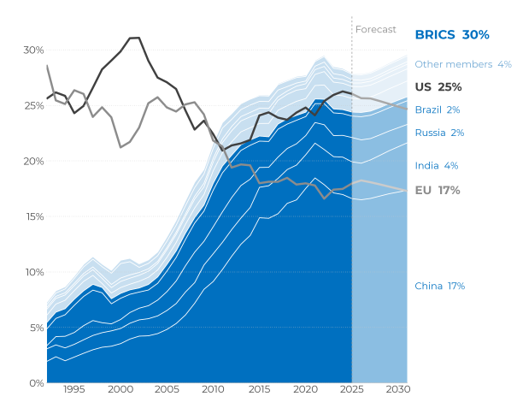
Source: IMF (Nominal GDP).
The BRICS+ have an outsized importance in global commodities
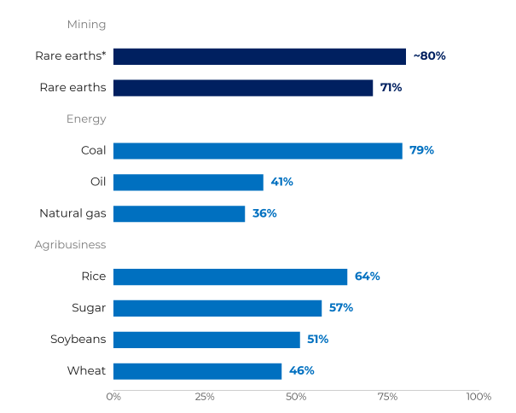
Source: USGS, Energy Institute, USDA. *Reserves, not production.
An intra-bloc payment system could reduce USD and SWIFT dependency in the long-term
The US dollar remains the dominant currency for international trade and financial market transactions across counterparties globally. The BRICS have been discussing new payment solutions for intra-bloc transactions since the mid-2010s, gaining additional significance as the trade activity within the group continue to expand and the incentives to reduce dollar dependency become more pronounced. Moreover, China has a stated goal of gradual RMB internationalization and estimates point to the share its goods trade settled in the currency nearly tripling in a decade to around one-third of total. While it may not intend to dethrone the dollar, it has a clear interest in extending relevance and trade channels.
The development of alternative payment rails for transactions within the grouping would not only increase the use of local currencies, but very importantly would limit the reliance on US and European financial infrastructure (like SWIFT), which still represents exposure to foreign economic and political influence. The BRICS solution under development also intends to increase transaction speed and reduce trade costs.
The creation of the independent payment system received a fresh push after sanctions to Russia in 2022 and on the heels of successful implantation of payment solutions like “UPI” in India and “Pix” in Brazil. As one of the key themes of the upcoming summit, BRICS Pay may garner renewed attention from the press and potentially from market participants too, especially if any indication is given about how quickly it can be launched and scaled. However, diverging levels of interest amidst the members and lack of consensus around the structure of a complex potential solution pose hurdles to it becoming a reality. Therefore, the potential creation and implementation of the network could happen only in the medium-term.
Global de-dollarization has limits
Emerging economies have increased the diversification of their funding sources since the Asian and Russian crises in the late 1990s, evidenced by a greater share of local public financing. Moreover, global dollar reserves have reduced from 70+% of total in the early 2000s to 56% in 2025, in a period where the EUR also gained prominence. While less dependent, the global economy continues to rely heavily on the dollar across FX trading, transnational payments and international debt issuance, as well as the recent record USD dollar inflows into US equities.
At the same time, domestic capital markets have become more mature for the BRICS. Taking Brazil as one example, the corporate financing via onshore debt markets nearly doubled within the past decade, reducing the reliance on private and state-owned banks. While the local market also goes through credit cycles, it provides corporates with an additional refinancing option, especially in periods where access to offshore capital is more demanding.
Reliance on external public funding has decreased
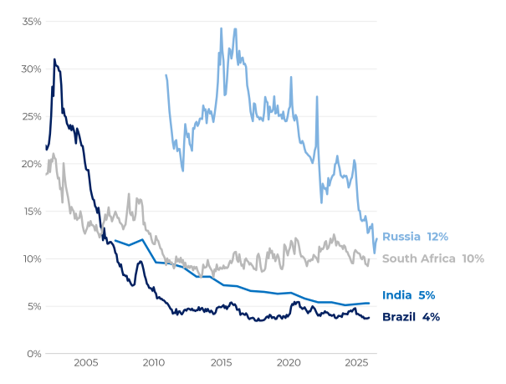
Source: Bloomberg, India from the Ministry of Finance.
Brazil local markets are now a major source of corporate funding
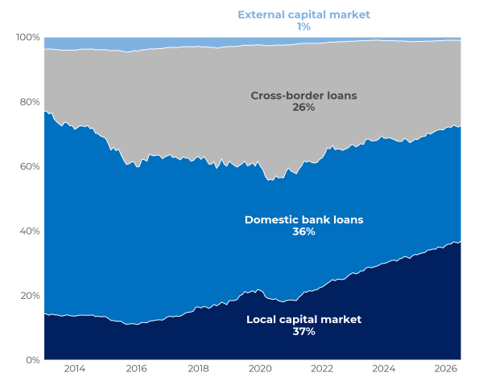
Source: BCB.
As China increases its relevancy in the global economy and as a trade partner, the issuance of Panda bonds from other EM countries has also become more frequent, including sovereign issuances from the Philippines, Indonesia and Argentina. In 2017, Russia’s RUSAL was one of the pioneering overseas corporates to access the Shanghai onshore bond market, while Brazil’s Suzano had its debut Chinese issuance as recently as 2025.
Portfolio positioning
The relevance of the BRICS in the global economy reinforces the growing importance of Emerging Markets as an asset class. The appreciation of EM currencies against the dollar bodes well for corporates with hard currency debt. The diversification of currencies and trading partners also reduces the dependency on counterparties, reducing the exposure to economic and geopolitical risk factors. While the upcoming summit has selected economic and political aspects to monitor, the limited coordination between the countries is expected to continue, likely not being a key driver of market performance.
Within the founding group, Brazil currently offers the most yield, with corporates averaging 7.1% (YTW). While the HY pocket has been volatile and the market monitors the upcoming electoral cycle, we continue to see select opportunities in the country.
DISCLAIMER – THIS DOCUMENT DOES NOT CONSTITUTE FINANCIAL ADVICE:
The information provided reflects the opinion of IVO Capital Partners at the date of this publication. The information contained in this document is not intended to be understood or interpreted as financial advice. It is shared for informational purposes only, does not constitute advertising, and should not be construed as a solicitation, offer, invitation, or inducement to buy or sell securities or related financial instruments in any jurisdiction. CONFIDENTIALITY NOTICE: The information herein is strictly confidential and may not be reproduced, redistributed, disclosed, or transmitted to any other person, directly or indirectly. You may not copy, reproduce, distribute, publish, display, modify, create derivative works from, transmit, or exploit this content in any manner, nor distribute any portion of it over a network, including a local network, sell or offer it for sale, or use it to construct any kind of database.